
Confirmation Bias in Buyers
And How Smart Marketing Helps Prospects Decide
Mohammad Danish
6/7/20264 min read
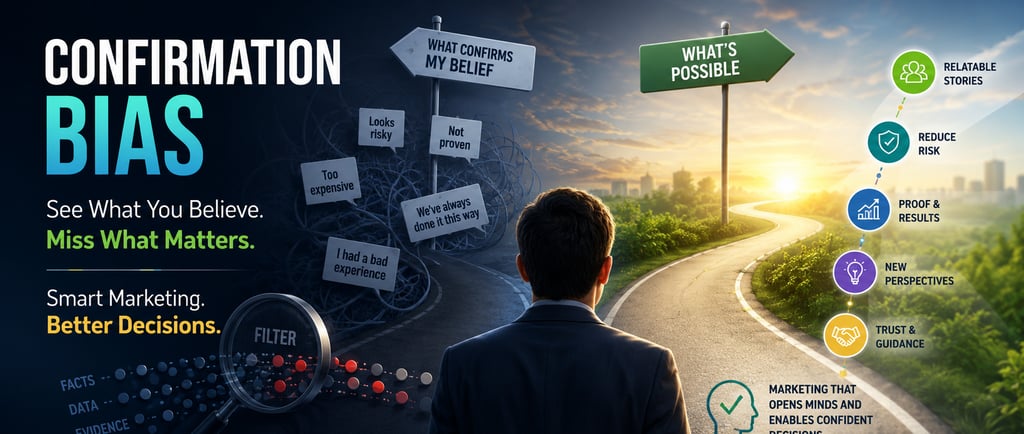
Modern buyers rarely evaluate products with complete neutrality. Long before they enter a sales call, download a whitepaper, or attend a webinar, they already carry assumptions, preferences, fears, loyalties, and beliefs. In psychology, this tendency is known as confirmation bias — the human habit of searching for, interpreting, and remembering information in ways that validate existing beliefs rather than challenge them. Confirmation Bias
For marketers, confirmation bias is both a challenge and an opportunity.
It explains why superior products sometimes lose to weaker competitors, why customers defend outdated systems, why procurement teams delay obvious upgrades, and why even data-driven buyers often make emotionally anchored decisions. Understanding confirmation bias allows marketers not only to improve conversions but also to genuinely help buyers make decisions with greater clarity and confidence.
What Is Confirmation Bias in Buying Behavior?
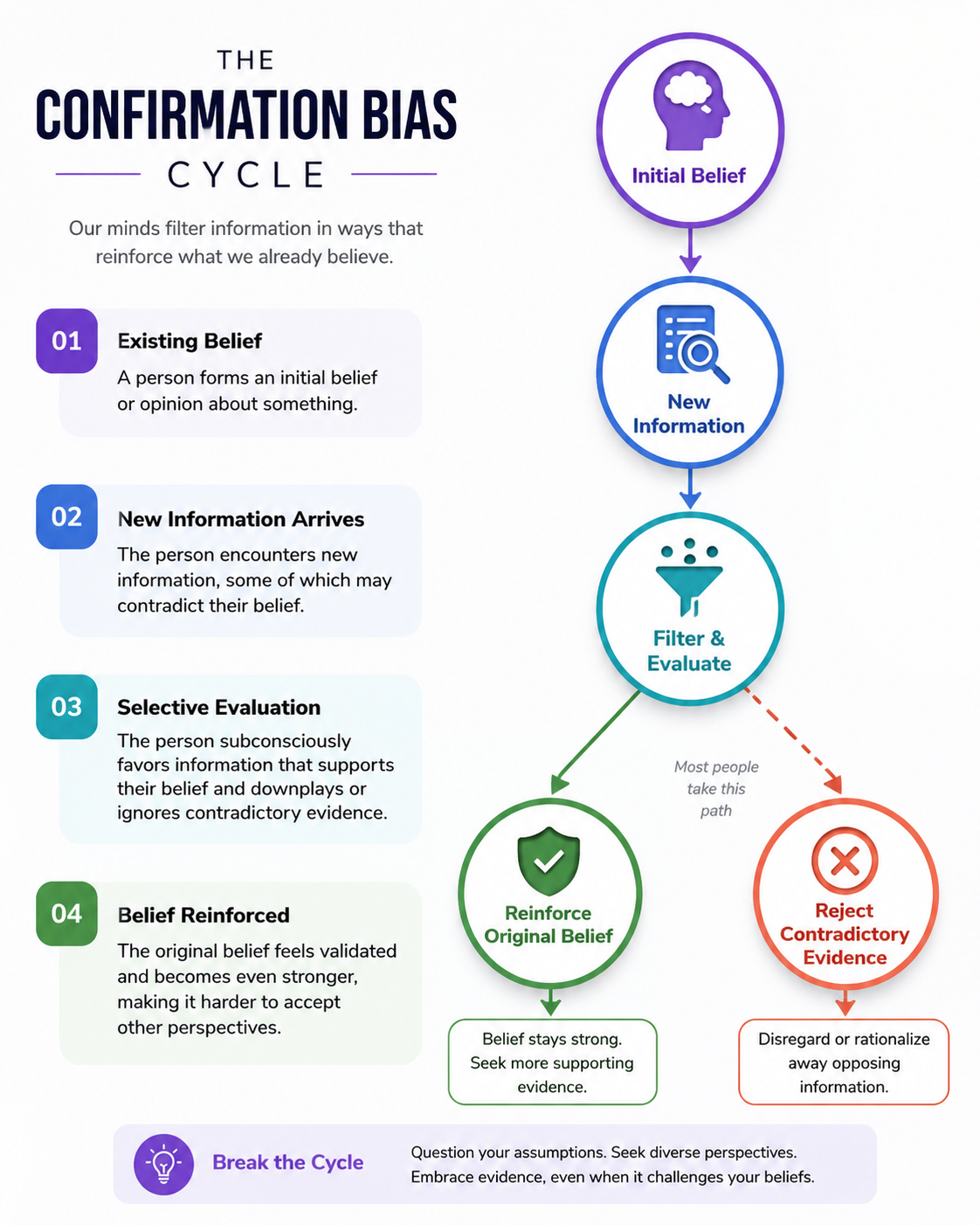
Confirmation bias occurs when buyers selectively notice information that supports what they already believe while dismissing contradictory evidence.
A customer who already believes “large enterprise software is safer” will naturally interpret market information in ways that reinforce that belief. A business owner who had one bad SaaS experience may automatically assume all subscription platforms are risky. A procurement manager who previously trusted a particular vendor may subconsciously defend that choice even when alternatives are objectively stronger.
The important insight is this: buyers do not simply evaluate information. They filter information through existing mental frameworks.
This becomes even stronger in B2B environments where decisions involve:
Career risk
Budget accountability
Team politics
Vendor relationships
Fear of operational disruption
Reputation inside the organization
In many cases, the buyer is not only trying to choose the best solution. They are trying to avoid being blamed for making the wrong choice.
Why Confirmation Bias Is So Powerful in B2B Marketing
B2B purchasing is deeply emotional beneath its rational surface. A company evaluating software may claim to prioritize:
Features
ROI
Integrations
Scalability
Security
Pricing
But underneath those criteria are emotional questions:
“Will this decision backfire on me?”
“Will leadership support this?”
“Will implementation become painful?”
“What if employees reject the tool?”
“What if the vendor disappears?”
“What if we commit and later regret it?”
Because of these fears, buyers naturally seek evidence that validates their existing comfort zones. This is why:
Legacy systems survive despite inefficiency
Well-known brands outperform technically superior newcomers
Buyers spend months “researching” without moving forward
Internal teams repeatedly revisit already-discussed concerns
Decision cycles become irrationally long
Confirmation bias often disguises itself as “careful evaluation.”
How Confirmation Bias Impacts Marketing Performance
Confirmation bias directly affects:
Click-through rates
Webinar engagement
Sales conversion
Trial activation
Renewal rates
Churn
Customer advocacy
For example, if a buyer already believes cloud migration is dangerous, they will pay disproportionate attention to downtime stories while ignoring successful deployments. Similarly, if a customer believes “AI-generated content lacks authenticity,” they will notice every awkward AI example while overlooking high-quality implementations. The marketer’s challenge is therefore not merely to provide information. It is to reduce psychological resistance.
The Wrong Way to Fight Confirmation Bias
Many marketers respond incorrectly by becoming more aggressive with facts. They increase:
Product comparisons
Technical specifications
ROI spreadsheets
Feature lists
Performance claims
Ironically, overwhelming buyers with contradictory information can strengthen confirmation bias instead of weakening it.
When people feel psychologically threatened, they often defend existing beliefs more aggressively. This is known as the backfire effect. A buyer emotionally attached to a belief does not want to feel “defeated.” They want to feel safe changing their mind.
How Smart Marketing Helps Buyers Reconsider Beliefs
The most effective marketing does not attack existing beliefs directly. It gently reframes them.
1. Start With Validation, Not Opposition
Buyers lower their defences when they feel understood.
Instead of saying: “Your current system is outdated.”
A smarter message is: “Many businesses hesitate to change systems because operational continuity matters.”
This acknowledges the buyer’s concern rather than dismissing it.
2. Use Social Proof Strategically
Humans trust peers more than brands.
Case studies work because they reduce uncertainty. When prospects see similar companies successfully adopting a solution, their brain begins adjusting its internal assumptions.
This is especially effective when the case study reflects:
Similar company size
Same geography
Similar industry
Comparable challenges
The psychological message becomes:
“People like us succeeded with this.”
3. Reduce Perceived Risk
Many buying objections are actually fear-management mechanisms. Marketers can reduce confirmation bias by lowering emotional risk through:
Free trials
Pilot programs
Flexible contracts
Local support
Transparent onboarding
Exit assurances
ROI modeling
Customer success visibility
The easier it feels to reverse a decision, the easier it becomes to make it.
4. Reframe Change as Progress, Not Disruption
Buyers resist identity-threatening decisions. A company proud of its existing systems may resist messaging that implies they were previously wrong. Smart marketers position adoption as evolution rather than correction. For example:
“As your business scales, your operational needs evolve.”
This preserves buyer dignity while encouraging movement.
5. Help Buyers Internally Justify the Decision
In B2B environments, buyers often need to “sell” the decision internally. Good marketing therefore creates tools that help prospects justify purchases:
Executive summaries
ROI calculators
Benchmark reports
Risk comparisons
Industry adoption data
Stakeholder-specific messaging
This transforms marketing from persuasion into decision enablement.
Confirmation Bias Is Not the Enemy
Confirmation bias is not irrational stupidity. It is a human cognitive protection mechanism. People use existing beliefs to simplify overwhelming complexity. In crowded software markets filled with competing claims, confirmation bias helps buyers reduce uncertainty and preserve psychological safety.
The best marketers understand this deeply. They do not manipulate buyers into decisions. They reduce fear, increase clarity, and create enough trust for prospects to reconsider assumptions on their own terms.
Ultimately, successful marketing is not about forcing belief change. It is about helping buyers feel safe enough to make a new decision.
Journey well taken
Sharing life insights on marketing and motorcycling adventures.
Connect
© 2026. All rights reserved.