
Deal Closed - Who's the winner?
Sales or Marketing?
Mohammad Danish
5/31/20264 min read


The ballroom lights dim. A giant screen flashes the words: “Strategic Partnership Announcement.” Cameras turn toward the stage. Executives shake hands. LinkedIn posts are already being drafted before the applause even settles. Somewhere in the audience, a salesperson exhales for the first time in eight months. Somewhere else, a marketer quietly opens their laptop to check attribution reports, campaign engagement numbers, and the next quarter’s pipeline forecast.
The world usually asks a simple question after a million-dollar deal closes:
“Who won it? Sales or Marketing?”
But the truth rarely fits inside a conference-room debate.
Because behind every large deal is not one hero, but two exhausted armies marching from different directions toward the same battlefield.
This is not a story about choosing between sales and marketing.
This is a documentary about the invisible war both teams fight every day.
Scene One: The Marketer’s War Room
The marketer arrives before sunrise. Dashboards glow across multiple monitors. Campaign numbers from Singapore, webinar registrations from Australia, click-through rates from Japan, partner enablement reports from India, content localization requests from Korea, budget approvals pending from finance, and a Slack message asking:
“Can we get more leads this quarter?”
Marketing operates in a strange paradox. When it works, nobody notices. When it fails, everyone notices immediately.
The marketer builds awareness among people who are not ready to buy yet. They create demand before sales conversations even exist. They fight algorithms, shrinking attention spans, rising ad costs, privacy laws, CRM inaccuracies, and internal skepticism.
A webinar gets 2,000 registrations. Sales asks: “How many converted?” A campaign generates 500 leads. Sales says: “They’re not qualified enough.” Marketing launches a brilliant brand campaign. Leadership asks: “What revenue did it directly influence?”
The marketer learns to live inside ambiguity. Their victories are often delayed, indirect, and difficult to measure with perfect precision. And yet, when the million-dollar client finally says,
“We’ve been following your company for years,”
that sentence was built quietly by marketing.
Every article. Every case study. Every event booth. Every email nurture. Every retargeting ad. Every customer review. Every social proof campaign. Every analyst report. Long before sales entered the room, marketing had already been there.
Now cut to the salesperson.
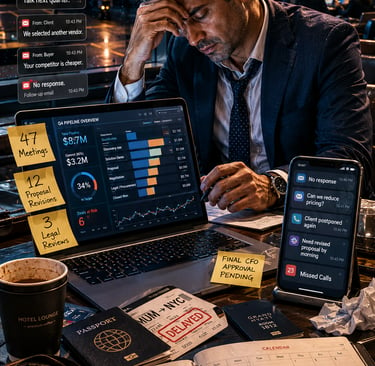
Airport terminals. Delayed flights. Hotel coffee at 11 PM. Quarter-end pressure. Procurement calls. Pricing negotiations. Endless follow-ups that receive no reply. The salesperson lives closest to rejection.
No response.
“Budget frozen.”
“Talk next quarter.”
“We selected another vendor.”
“Your competitor is cheaper.”
Unlike marketing, whose failures can sometimes hide behind trends and analytics, sales failures arrive personally. Directly. Human to human.
A salesperson may spend six months building a relationship only to lose the deal in the final week because a CFO changed priorities overnight.
And yet they return the next morning. Because sales is not just persuasion. It is emotional endurance.
The best salespeople become psychologists, negotiators, consultants, therapists, and occasionally crisis managers. They absorb customer frustration while internally carrying their own.
Targets do not care about birthdays. Pipelines do not pause for family emergencies. Quotas continue through illness, exhaustion, and uncertainty.
The million-dollar deal eventually closes after 47 meetings, 12 revised proposals, 3 legal reviews, and countless moments where the customer nearly walked away.
The handshake on stage lasts seven seconds. The struggle behind it lasted a year.
Scene Two: The Salesperson’s Battlefield
Scene Three: The Quiet Conflict Between Them
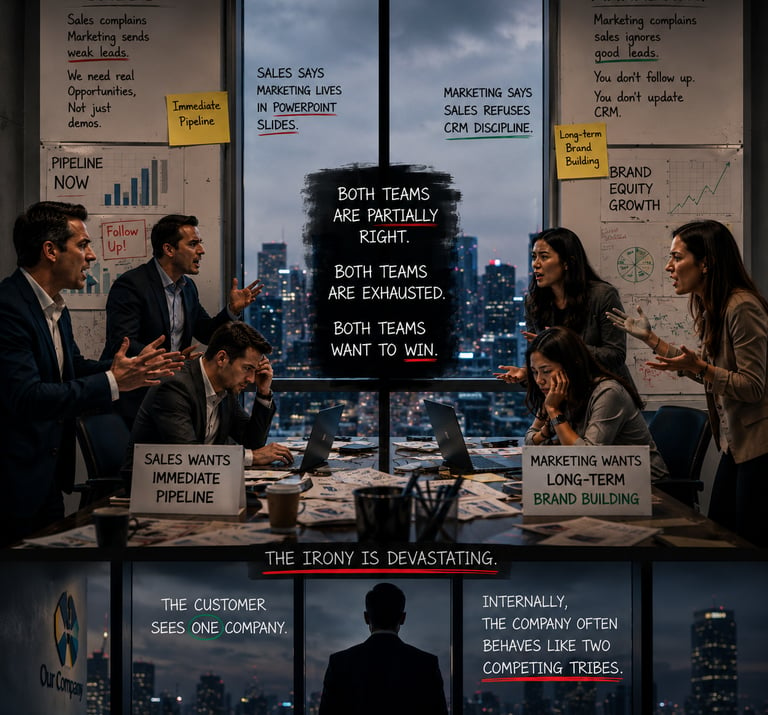
Sales complains that marketing sends weak leads.
Marketing complains that sales ignores good leads.
Sales says marketing lives in PowerPoint slides.
Marketing says sales refuses CRM discipline.
Sales wants immediate pipeline.
Marketing wants long-term brand building.
Both teams are partially right.
And both teams are often too exhausted to fully understand the pressures the other side carries.
The irony is devastating.
The customer sees one company.
Internally, the company often behaves like two competing tribes.
Scene Four: The Human Side Nobody Sees
Behind the dashboards and targets are ordinary people trying to hold together extraordinary pressure.
A marketer presenting campaign ROI while worrying about their child’s school fees.
A salesperson smiling confidently during a client dinner after spending the afternoon in a hospital with a parent.
Late-night laptop screens beside sleeping spouses.
Missed anniversaries because quarter-end numbers matter more.
Vacations interrupted by “urgent client escalations.”
Mental exhaustion hidden behind corporate professionalism. The million-dollar deal is celebrated publicly. The sacrifices behind it remain mostly undocumented.
Final Scene: So Who Wins the Deal?
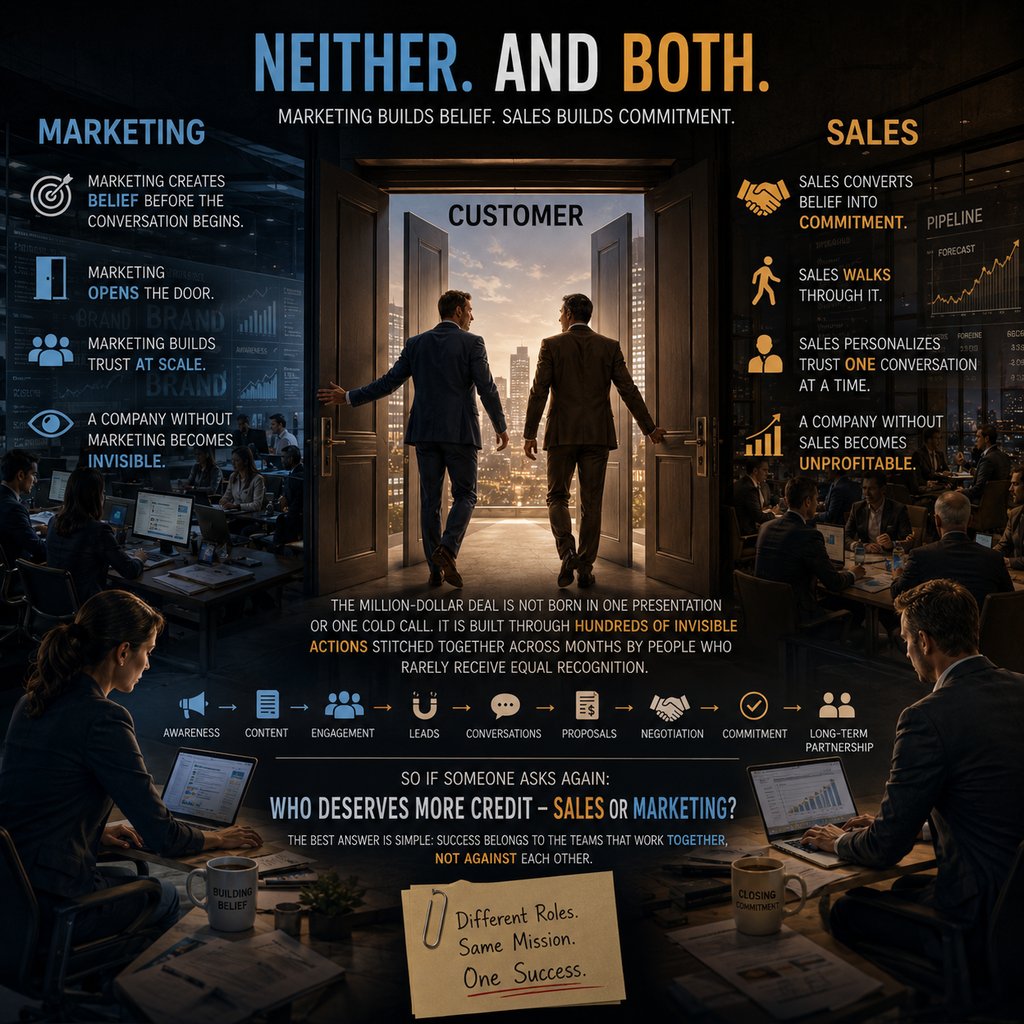
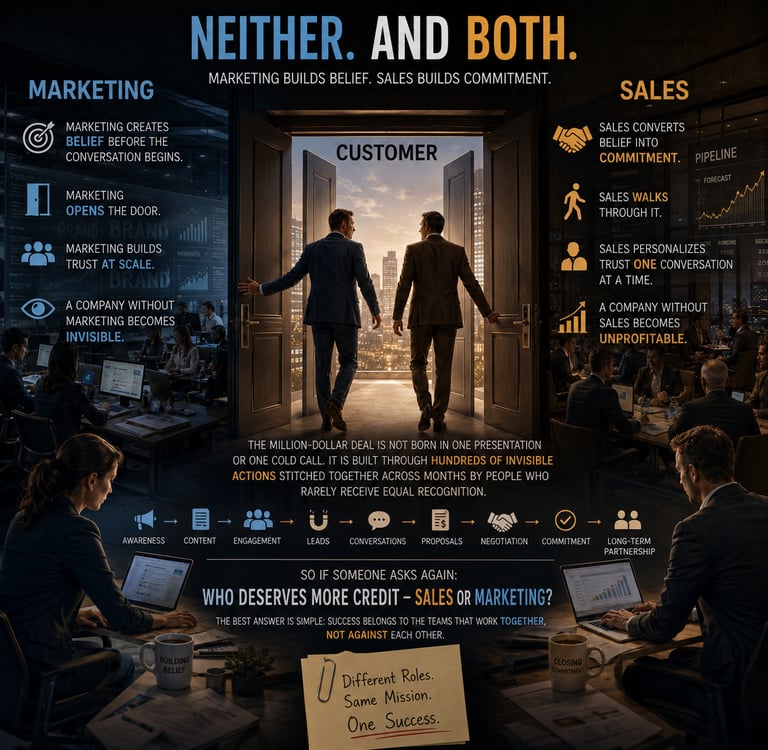
Neither. And both.
Marketing creates belief before the conversation begins.
Sales converts belief into commitment.
Marketing opens the door.
Sales walks through it.
Marketing builds trust at scale.
Sales personalizes trust one conversation at a time.
A company without marketing becomes invisible.
A company without sales becomes unprofitable.
The million-dollar deal is not born in one presentation or one cold call. It is built through hundreds of invisible actions stitched together across months by people who rarely receive equal recognition.
So if someone asks again:
“Who deserves more credit — sales or marketing?”
Perhaps the better answer is this: The real victory belongs to the organizations where neither team is trying to win against the other. Because the strongest revenue engines are not built on rivalry. They are built on alignment.





Journey well taken
Sharing life insights on marketing and motorcycling adventures.
Connect
© 2026. All rights reserved.