
Emotional Forecasting in Marketing
Predicting Human Feelings Before Predicting Revenue
Mohammad Danish
6/7/20264 min read
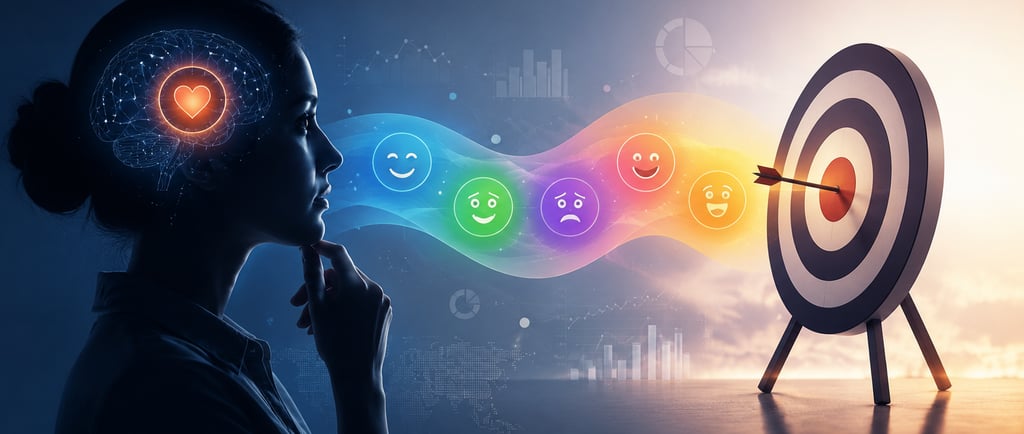
Marketing teams spend enormous amounts of time forecasting clicks, impressions, leads, pipeline contribution, conversion rates, CAC, and ROI. Dashboards are filled with numbers. Attribution models become more sophisticated every year. Yet one of the most powerful predictors of marketing success is often ignored: how people expect they will feel before they make a decision.
This is where emotional forecasting becomes a strategic advantage.
Emotional forecasting is the process of predicting how audiences will emotionally react to an experience, product, campaign, or decision in the future. In psychology, it is closely linked to “affective forecasting,” a concept studied extensively by researchers like Daniel Gilbert and Timothy Wilson. Their research showed that humans constantly make decisions based not only on logic, but on anticipated emotions. People buy products because they expect relief, confidence, belonging, pride, status, safety, nostalgia, hope, or excitement.¹
Most marketing forecasting models fail because they treat customers as rational spreadsheets rather than emotional prediction engines.
The Hidden Layer Beneath Marketing Metrics
A person rarely buys software because of its features alone. They buy what they believe life will feel like after adoption.
A gym subscription is not merely about equipment. It is about imagining future confidence.
A cybersecurity solution is not only about protection. It is about reducing executive anxiety.
A luxury motorcycle is not transportation. It is identity, freedom, and self-expression.
A B2B SaaS platform is often purchased because a manager imagines reduced stress before quarterly reviews.
Traditional forecasting models measure past actions. Emotional forecasting attempts to predict future emotional states driving those actions.
This distinction matters enormously.
A campaign may generate high engagement but low conversions because it created curiosity without emotional certainty. Another campaign with lower traffic may outperform because it created emotional reassurance and reduced perceived risk.
The strongest marketers do not merely ask:
“What will customers click?”
They ask:
“How will customers expect to feel if they say yes?”
Why Emotional Forecasting Matters More in Modern Marketing
Digital saturation has created a paradox. Consumers have more information than ever, but less emotional clarity.
Thousands of ads compete simultaneously across platforms. Most are technically optimized but emotionally empty. As automation improves, emotional differentiation becomes one of the last remaining competitive advantages.
This is especially visible in B2B marketing.
For years, B2B marketers assumed decisions were purely rational. Research from Google and CEB showed that emotional connection significantly influences B2B purchase behavior, often more strongly than in consumer markets because professional decisions carry career risk.²
A CIO choosing enterprise software is not just evaluating functionality. They are subconsciously forecasting:
Will this make me look competent?
Will implementation become a disaster?
Will leadership trust me?
Will this reduce pressure on my team?
Will this decision threaten my reputation?
This emotional layer often explains why objectively “better” products lose to emotionally safer brands.
Building Emotional Forecasting into Marketing Strategy
1. Forecast Emotional States, Not Just Personas
Traditional personas focus on demographics:
Age
Industry
Income
Geography
Job title
Emotional forecasting requires deeper dimensions:
What fear dominates their decision?
What future are they hoping to avoid?
What identity are they trying to reinforce?
What emotional reward do they seek?
For example, two CMOs may share identical company sizes and budgets yet behave completely differently emotionally. One may seek innovation recognition. Another may prioritize job security.
Their emotional forecasts drive campaign response far more than demographic similarity.
2. Map the Emotional Journey Across Funnel Stages
Every funnel stage carries a different emotional state.
Awareness Stage Emotion: curiosity, frustration, aspiration
Consideration Stage Emotion: uncertainty, skepticism, anxiety
Decision Stage Emotion: fear of making the wrong choice
Post-Purchase Stage Emotion: validation or regret
Strong marketers create campaigns aligned with these emotional transitions rather than forcing the same message everywhere. A common mistake is using aggressive conversion messaging too early. Customers emotionally are not yet ready for commitment. They still seek reassurance and understanding.
3. Use Historical Emotional Signals
Modern analytics often ignore emotional indicators hidden inside existing data:
Comment sentiment
Call transcripts
Webinar questions
Sales objections
Customer reviews
Community discussions
Social listening
Patterns emerge quickly.
For instance:
Fear-heavy language predicts longer buying cycles.
Hope-oriented language predicts higher referral likelihood.
Pride-oriented language predicts stronger social sharing.
Anxiety-oriented messaging increases short-term conversions but may increase churn.
The future of predictive marketing will increasingly combine behavioral analytics with emotional pattern recognition.
4. Predict Emotional Fatigue
One overlooked dimension of forecasting is emotional exhaustion. Audiences eventually become numb to urgency-based messaging:
“Limited time offer”
“Act now”
“Last chance”
“Only today”
When every campaign creates artificial pressure, audiences emotionally disengage.
Brands that understand emotional forecasting know when to reduce intensity and introduce trust, calmness, humor, or authenticity. This is why some minimalist campaigns outperform louder competitors. Emotional contrast becomes memorable.
5. Align Creative Teams with Emotional Outcomes
Most creative briefs discuss:
Target audience
CTA
Channels
Deliverables
Timeline
Very few specify: “What should the audience feel immediately after seeing this?” That question changes everything. Because emotional forecasting forces alignment between:
Design
Copy
Messaging
Timing
Audience psychology
Business outcome
The best campaigns are emotionally engineered, not merely visually attractive.
The Future: AI + Emotional Forecasting
AI is transforming predictive marketing rapidly. But the next evolution is not only behavioral prediction. It is emotional prediction.
Future systems will likely analyze:
Voice tone
Facial reactions
Language intensity
Engagement rhythm
Emotional sentiment shifts
Community mood patterns
Brands will increasingly forecast not just who will buy, but when audiences are emotionally prepared to buy. The companies that master this balance between data science and human psychology will outperform those relying only on dashboards. Because ultimately, markets are not driven purely by logic. They are driven by human beings imagining future emotional outcomes before making decisions.
And the marketer who can predict emotion often predicts revenue earlier than everyone else.
References
Stumbling on Happiness – Daniel Gilbert
Google & CEB, “The Emotional Connection Between B2B Buyers and Brands”
Thinking, Fast and Slow – Daniel Kahneman
Predictably Irrational – Dan Ariely
Behavioral Economics research on affective decision-making and consumer psychology
Journey well taken
Sharing life insights on marketing and motorcycling adventures.
Connect
© 2026. All rights reserved.