
Proudly Imported
Perhaps the question is not whether imported products are good. Many of them are exceptional. The better question is why we are comfortable celebrating imports while investing so little energy in becoming exporters of innovation ourselves.
Mohammad Danish
6/19/20265 min read
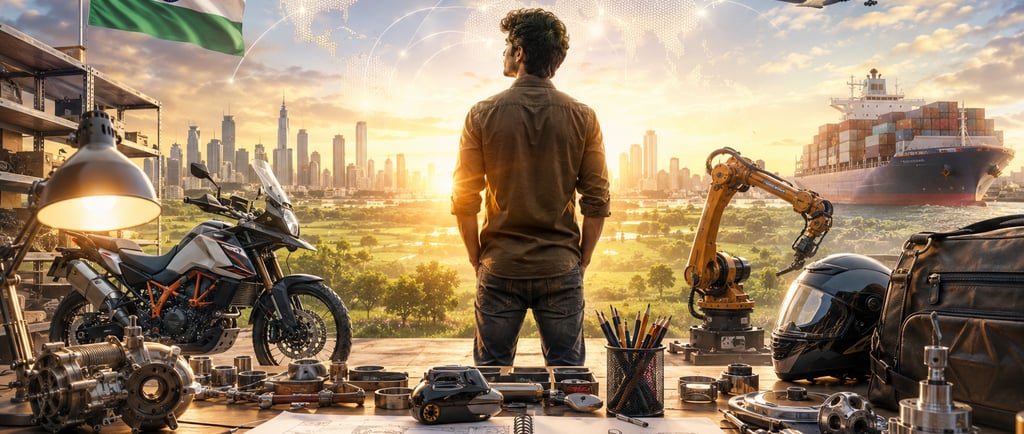
A few days ago, while researching accessories for my motorcycle, I found myself going down a familiar rabbit hole. Like most enthusiasts, I started with a simple question: which products are worth buying? A few YouTube videos later, I was comparing crash guards, luggage systems, auxiliary lights, navigation mounts, riding gear and suspension upgrades. The reviews were detailed, the creators were knowledgeable, and the products looked impressive. What caught my attention, however, was not the products themselves. It was a word: imported.
Again and again, reviewers spoke about imported products with a certain admiration. Imported lights. Imported luggage systems. Imported riding gear. Imported performance components. The word was almost always presented as a guarantee of superiority. It was not merely describing where the product came from; it was being used as a symbol of quality, prestige and desirability. And that left me wondering: should we really feel proud when we say something is imported?
Perhaps this question stayed with me because I had recently watched the story of Titan on Amazon Prime. The story follows a period when the Indian watch market was dominated by foreign brands and imported prestige. Watches from Switzerland and Japan represented aspiration, while Indian-made products were often seen as inferior by default. Titan did not simply set out to manufacture watches. It set out to challenge a mindset. The company's battle was not merely against foreign competition; it was against the belief that world-class quality could not emerge from India. Watching that story, one realizes that the biggest obstacle to industrial growth is often psychological. Before a nation can build products that compete globally, it must first believe that it can.
That lesson came back to me while watching motorcycle accessory reviews.
There is nothing wrong with buying products from around the world. Global trade has improved lives, increased choices and accelerated innovation. The issue is not importing. The issue is when importing becomes a point of pride because it highlights something we are unable to make ourselves. As consumers, we rarely think beyond the product in front of us. We see the polished finish, the engineering, the reliability and the performance. What we do not see are the decades of investment in research, testing, product development, manufacturing discipline, patents, certification and industrial policy that made that product possible.
The countries whose products we admire today did not become leaders by consuming the best products in the world. They became leaders by creating them. Israel spends over 6% of its GDP on research and development, South Korea more than 5%, while Japan, the United States and Germany spend above 3%. India, by comparison, has remained around 0.6% to 0.7% of GDP for years. That difference is not just a statistic. It is the distance between a country that invents, patents, tests, scales and exports, and a country that often waits until someone else has solved the problem.
Germany did not become synonymous with engineering excellence by importing machinery. Japan did not build its reputation for reliability by purchasing foreign technology indefinitely. South Korea did not transform itself into a global industrial powerhouse by remaining dependent on others for innovation. China, despite the criticism often directed at its manufacturing practices, spent decades investing aggressively in industrial capabilities, engineering education, infrastructure and research before becoming a dominant force in global manufacturing. They all understood something fundamental: long-term prosperity comes from production, not consumption.
That distinction matters because a nation that primarily consumes wealth eventually becomes dependent on those who create it. Every imported product represents value created elsewhere. The design happened elsewhere. The patents were registered elsewhere. The high-paying engineering jobs exist elsewhere. The profits flow elsewhere. The intellectual property belongs elsewhere.
Meanwhile, the importing country gets the finished product and little else.
India has made remarkable progress as a startup nation, but the path from idea to enterprise remains far more difficult than many realize. Starting a company may require only a few clicks online, but building one is another matter entirely. A founder without family wealth, political connections, established networks or administrative influence often spends more time overcoming friction than building products. Accessing credit remains difficult. Testing facilities can be expensive. Compliance requirements consume valuable time. Manufacturing startups require machinery, tooling, certifications, inventory and distribution before the first meaningful revenue arrives.
This is where many promising ideas quietly disappear. Not because the founders lacked talent. Not because the products lacked potential. But because the ecosystem lacked patience.
A brilliant engineer with a breakthrough motorcycle accessory, battery technology or safety product often finds himself competing not only against established global brands but also against funding challenges, regulatory complexity, certification costs and market skepticism. By contrast, countries that dominate manufacturing have spent decades building support structures around innovators. Universities collaborate with industry. Governments fund research. Venture capital understands hardware. Testing infrastructure is accessible. Failure is treated as a lesson rather than a permanent scar.
The irony is that India possesses nearly every ingredient required to become a global innovation leader. We have a vast domestic market, some of the world's best engineering talent, a thriving startup ecosystem, strong software capabilities and an entrepreneurial culture. Yet our investment in research and development remains significantly lower than many countries that dominate high-value manufacturing and technology exports.
And perhaps that is why the Titan story resonates so deeply.
Titan did not succeed because Indians suddenly became patriotic consumers. Titan succeeded because it delivered quality. It invested in design. It invested in manufacturing. It invested in trust. It created products that consumers genuinely wanted. Over time, it changed perceptions. What was once considered impossible became normal. Today, an Indian watch brand competes confidently against global names, not because consumers are making a sacrifice, but because the product has earned its place.
The same transformation is possible across countless industries.
Imagine if every motorcycle accessory that Indian riders currently import had an Indian equivalent that matched or exceeded global standards. Imagine those products being exported to Europe, Australia, Southeast Asia and North America. Imagine Indian engineers designing the benchmark for adventure-touring luggage systems, rider safety technology, suspension systems or navigation solutions.
The objective should never be "Buy Indian regardless of quality."
The objective should be "Build Indian products that compete on quality."
Government policy can play a significant role in making that happen. Tax incentives for R&D, grants for product development, faster patent approvals, stronger university-industry partnerships, easier access to testing facilities, export promotion programs and low-cost manufacturing credit can create an environment where innovation thrives rather than struggles to survive.
Because quality should always win.
Nobody wants inferior products wrapped in patriotic messaging. Consumers are right to demand excellence. But excellence itself should become a national ambition.
Perhaps the question is not whether imported products are good. Many of them are exceptional. The better question is why we are comfortable celebrating imports while investing so little energy in becoming exporters of innovation ourselves.
The day an enthusiast in Germany proudly installs an Indian-made motorcycle accessory because it is the best product available—not the cheapest, not the patriotic choice, but simply the best—we will know that something fundamental has changed.
That was the dream behind Titan. It should be the dream behind every Indian manufacturing success story that follows. And that is a label worth being proud of.
Journey well taken
Sharing life insights on marketing and motorcycling adventures.
Connect
© 2026. All rights reserved.